

1. What is the meaning of this sign?
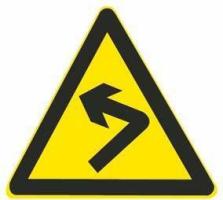
A. Bypass from left side
B. Continuous curves
C. Sharp left curve
D. Sharp right curve
Answer: C
2. When driving on a road covered with ice and snow, the motor vehicle may spin or slide when increasing the speed urgently, due to the loss of vehicle stability.
A. Right
B. Wrong
Answer: A
3. How will the adhesive force of road change when speed increases on a damp and slippery road?
A. Increase sharply
B. Increase gradually
C. Decrease sharply
D. No change
Answer: C
4. What should the driver pay attention to when the motor vehicle passes a school?
A. Observe the traffic signs and markings
B. Slow down and pass slowly
C. Prohibited from sounding the horn
D. Pass rapidly
Answer: ABC
5. Sounding the horn on a foggy daY can arouse the attention of the opposite side. After hearing the horn from the opposite side, the driver should also sound their own horn to respond.
A. Right
B. Wrong
Answer: A
6. When following other vehicles on the uphill section of a mountain road, what should the driver do if the vehicle in front stops?
A. Overtake from either side of the front vehicle
B. Stop close to the vehicle in front
C. Stop with a larger space from the vehicle in front
D. Sound the horn continuously to warn the other driver
Answer: C
7. What is the meaning of this sign?
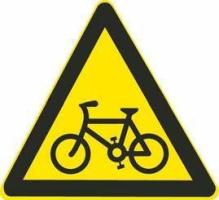
A. The lane for non-motorized vehicles
B. Yield non-motorized vehicles
C. No passing for non-motorized vehicles
D. Watch for non-motorized vehicles
Answer: D
8. When approaching a vehicle on a narrow slope, which one of the following ways is correct?
A. The descending vehicle yields to the ascending
B. The vehicle which is further from the slope crest should yield
C. The ascending vehicle yields to the descending
D. If the descending vehicle has reached the midpoint while the ascending vehicle has not yet set out, the descending vehicle must yield.
Answer: A
9. After setting off from a roadside, motor vehicle drivers should watch both sides of the road, turn left and drive into the normal lane slowly.
A. Right
B. Wrong
Answer: A
10. What is the main impact of foggy weather on safe driving?
A. Easy to slide sideways
B. Low visibility
C. Increase the resistance
D. Widen the field of vision
Answer: B
11. How should lamps be used by the motor vehicle driver who follows a vehicle on a road section at night where he street light condition is good?
A. Turn off the headlamp
B. Use high-beam
C. Turn off all lamps
D. Use low-beam
Answer: D
12. When a wounded person suffering bone fracture in the thigh, shank and spine, it is necessary to keep the fracture in position and refrain to move the wounded person.
A. Right
B. Wrong
Answer: A
13. When a motor vehicle temporarily stops at night, which lamp should be turned on?
A. Front and rear fog lamp, clearance lamp and rear position lamp
B. Head lamp, clearance lamp and rear position lamp
C. Hazard lamp, clearance lamp and rear position lamp
D. Reverse lamp, clearance lamp and rear position lamp
Answer: C
14. When a motor vehicle moves through water, drivers should intermittently and gently depress the brake pedal in order to restore braking efficiency.
A. Right
B. Wrong
Answer: A
15. Drivers should wear shoes or boots, which have heels and not skid soles, to ensure the acute, accurate, and reliable gear-shifting by feet.
A. Right
B. Wrong
Answer: A
16. When driving in rain and encountering pedestrians with umbrellas or wearing raincoats, what should be done by motor vehicle drivers in order to yield?
A. Drive at a normal speed
B. Sound the horn to alert when approaching the pedestrians
C. Speed up and bypass on the left
D. Reduce speed and sound the horn in advance
Answer: D
17. When there is bleeding at the bone fracture of a wounded person, the first thing to do is to fix the wounded part in position, then stop the bleeding and dress the wound.
A. Right
B. Wrong
Answer: B
18. When passing a turn or a curve section, the driver should slow down and disengage the clutch.
A. Right
B. Wrong
Answer: B
19. What is the purpose of checking before driving?
A. Confirm whether the tyres of motor vehicles are damaged or not
B. Confirm whether there is a safety hazard near the vehicle.
C. Confirm whether there are obstacles around the vehicle
D. Confirm whether the road in front of the vehicle is safe
Answer: ABCD
20. When a motorcycle wades across the water, the braking efficiency of the brake does not change.
A. Right
B. Wrong
Answer: B