

1. When a tire bursts suddenly on the road, the driver should refrain from violently depressing the brake pedal in panic. Instead, he/she should try his/her best to change to a low gear and use engine braking to reduce the speed of the vehicle.
A. Right
B. Wrong
Answer: A
2. Which of the following can effectively avoid driving fatigue
A. Take a proper rest after dinner before driving.
B. Driving continuously for no more than 4 hours
C. Keep a Good Sleep
D. Do npt eat too much
Answer: ABCD
3. When a wounded person suffering burns is thirsty, he should only drink plain boiled water.
A. Right
B. Wrong
Answer: B
4. What is the meaning of this sign?
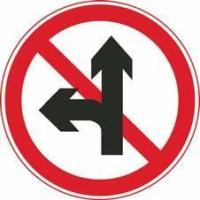
A. No going straight and no changing to left lane
B. No going straight and no left turn
C. Allowed to go straight and turn left
D. No going straight and no right turn
Answer: B
5. Which measures is correct when a motor vehicle turn around?
A. Turn around in the turning lane
B. Should not turn on the turning light
C. Turn around in the straight lane
D. Turn on the left-turn signal in advance
Answer: AD
6. When a motor vehicle passes over an inundated road drivers should change to a high gear and pass rapidly.
A. Right
B. Wrong
Answer: B
7. Motor vehicle drivers don’t need to use any lamp at night when passing through a road section where the street light condition is good.
A. Right
B. Wrong
Answer: B
8. What are the main reasons why driving a motor vehicle should not overtake on rainy days?
A. It is not easy for drivers around to see the overtaking signal.
B. Can not accurately judge the distance of vehicles around
C. Road is wet and slippery, and vehicles are prone to sideslip
D. The driver can not detect dangerous in time
Answer: ABCD
9. When the wounded person is suffering main artery bleeding, where should the rescue personnel press by thumb to stop the bleeding?
A. The artery near the heart
B. The artery lower to the wound
C. The artery further from the heart
D. The artery in the center of the wound
Answer: A
10. Why is it dangerous to overtake on a snowy mud road in heavy snow?
A. Snow can increase tire adhesion
B. The flying mud made the sight bad.
C. Long braking distance in case of emergency
D. Pavement under snow and mud is easier to skid.
Answer: BCD
11. What is the most frequent problem for driving on a muddy road?
A. High resistance force
B. Sideways slide
C. The motor vehicle bumps
D. Steering failure
Answer: B
12. What is the meaning of this sign?
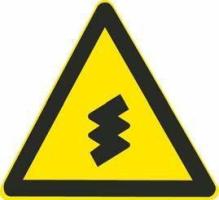
A. Slippery section
B. Sharp curve
C. Inverse curve
D. Continuous curves
Answer: D
13. When a motor vehicle encounters an accident, the driver should pay attention to whether there is fuel leakage, pipeline rupture, so as avoid accidents.
A. Right
B. Wrong
Answer: A
14. After a tire blows out and before the driver can control the speed of the vehicle, he should refrain from using the foot brake to stop the vehicle. Otherwise, a horizontal swing of the vehicle can cause greater danger.
A. Right
B. Wrong
Answer: A
15. When a gas tanker is leaking heavily, which of the following measures is wrong?
A. Cut off the power
B. Wear gas mask and protect gloves
C. Turn off the valve to stop leaking
D. Evacuate people to the leeward side
Answer: D
16. When rescuing a wounded person who has been poisoned by toxic gas, the first measure is to send him to a place where air is fresh so that he will not continue to be poisoned.
A. Right
B. Wrong
Answer: A
17. When rescuing a wounded person in an emergency, it is necessary to firstly stop the bleeding by compression before other methods are taken according to the conditions of bleeding.
A. Right
B. Wrong
Answer: A
18. Which of the following measures is incorrect when a motor vehicle stops?
A. Stop at a stipulated place
B. Avoid stopping on pedestrian streets
C. Avoid obstructing the passing of other motor vehicles and pedestrians when temporarily stops on the road
D. Stop on the non-motor vehicle lane
Answer: D
19. Motor vehicle drivers may borrow a special lane for other vehicle types, if one exists, to overtake.
A. Right
B. Wrong
Answer: B
20. Whats the meaning of the double white broken lines in far front of the intersection?
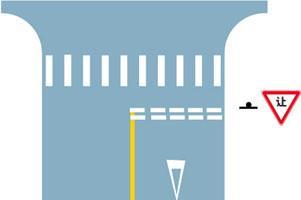
A. Waiting to run line
B. Stopping and yield line
C. Slowdown and yield line
D. Left-turn waiting line
Answer: C