

1. Keep enough safe distance When a motor vehicle follows another vehicle, because ______.
A. Avoke a rear-end collision
B. The closer you get to the vehicle, the less easy it is to grasp the situation ahead of the vehicle.
C. Enough distance to avoid emergencies
D. Prevent being unable to detect the front vehicle brake in time due to the damage rear lamp of the front vehicle
Answer: ABCD
2. When the tire pressure is too low, what can happen when driving at a high speed?
A. Tire pressure will be unstable
B. Tire pressure will increase
C. Driving resistance will decrease
D. The tire will burst
Answer: D
3. What is the meaning of this sign?
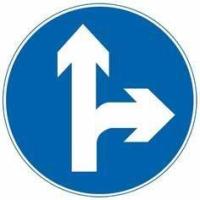
A. Going straight and left turn
B. Going straight and right turn
C. No going straight and no right turn
D. Left turn and right turn only
Answer: B
4. When encountering an obstacle on one side of the road, what should vehicles do as they approach each other?
A. The vehicle not encountering an obstacle should Yield to the other vehicle
B. The slower vehicle should yield to the faster
C. The vehicle encountering an obstacle should yield to the other vehicle
D. The faster vehicle should yield to the slower
Answer: C
5. What is the meaning of this sign?

A. Embankment road
B. Steep uphill road
C. Continuous up slopes
D. Steep downhill road
Answer: D
6. When driving, besides paying attention to keeping a safe distance from the vehicle in front, drivers should also be prudent when braking so as to avoid a rear-end collision caused by a vehicle behind.
A. Right
B. Wrong
Answer: A
7. Once inflammable gas causes a fire disaster, it should be put out with water in good time.
A. Right
B. Wrong
Answer: B
8. What is the meaning of this sign?

A. Bump road
B. Low-lying road
C. High outburst road
D. Hump bridge
Answer: B
9. Dangerous chemicals possess the characteristics of explosion, inflammation, poison, erosion and radiation.
A. Right
B. Wrong
Answer: A
10. When the motor vehicle encounters a crosswalk in this situation, the driver may speed up and pass rapidly.

A. Right
B. Wrong
Answer: B
11. What is the meaning of this sign?
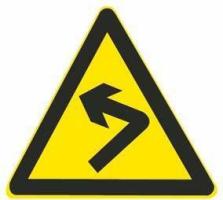
A. Bypass from left side
B. Continuous curves
C. Sharp left curve
D. Sharp right curve
Answer: C
12. When rescuing a person sustaining full-body burns the rescue personnel may spray cool water to his body to put out the fire.
A. Right
B. Wrong
Answer: B
13. Before riding a motorcycle, the driver should wear a safety helmet and adjust the angle of the rearview mirror till he can clearly watch the left side and the right side of the back.
A. Right
B. Wrong
Answer: A
14. When the driver discovers a tire is leaking and steers the vehicle off the main driving lane, he/she should refrain from applying emergency braking so as to avoid a vehicle turnover or a rear-end collision arising from the late braking of the vehicle behind.
A. Right
B. Wrong
Answer: A
15. Under such circumstances, motor vehicle drivers may sound the horn at the proper time and speed up to pass through.

A. Right
B. Wrong
Answer: B
16. The motor vehicle should speed up and pass rapidly under this situation.
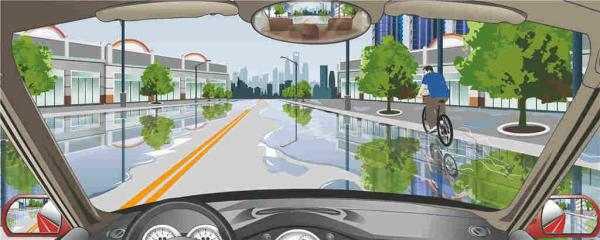
A. Right
B. Wrong
Answer: B
17. Driving a motor vehicle in the downhill section of a mountain road avoids overtaking as much as possible because _______.
A. Vehicle resistance in downhill section is very high
B. Vehicles on downhill sections are more difficult to control than on flat roads due to gravity.
C. In downhill section, the front speed is faster and it is difficult to overtake.
D. Vehicles on downhill sections tend to be too fast due to gravity
Answer: BD
18. What should the driver do when the motor vehicle counters this situation?
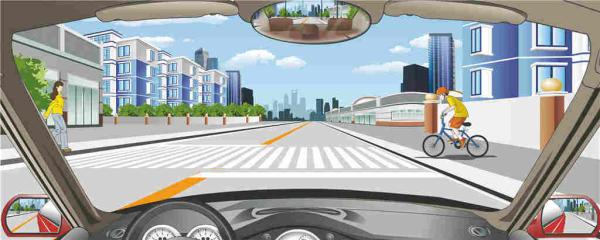
A. Sound the horn continuously to warn
B. Speed up and bypass from the front
C. Slow down when encountering any risks
D. Slow down voluntarily and yield
Answer: D
19. When approaching a sharp curve, motor vehicle drivers should reduce speed only after entering the curve.
A. Right
B. Wrong
Answer: B
20. When driving on a road covered with ice and snow, drivers tend to encounter glare caused by reflection of light rays from the road surface.
A. Right
B. Wrong
Answer: A