

1. What are the main reasons why driving a motor vehicle should not overtake on rainy days?
A. It is not easy for drivers around to see the overtaking signal.
B. Can not accurately judge the distance of vehicles around
C. Road is wet and slippery, and vehicles are prone to sideslip
D. The driver can not detect dangerous in time
Answer: ABCD
2. The wrong measure to ride a motorcycle in summer is to __________.
A. Drive at a high speed for a long time
B. Control the speed by the accelerator
C. Avoid using the brake
D. Avoid loading people or cargoes
Answer: A
3. When a motorcycle goes down a long slope, it should run at a lower gear and fully use the engine to brake.
A. Right
B. Wrong
Answer: A
4. When the vehicles cross each other at night, what should the driver do if the vehicle coming in the opposite direction always use the high beam light.
A. Continuous change lights and honk to remind the vehicle coming in the opposite direction
B. Turn on the high beam light
C. Reduce speed or driving on the right side.
D. Move his sight to the right side to evade the light
Answer: CD
5. Under such circumstances, what should motor vehicle drivers do?

A. Pass slowly at a lower speed
B. Speed up and pass
C. Continuously sound the horn and pass
D. Pass at a normal speed
Answer: A
6. When passing an intersection, vehicle motor drivers are not allowed to overtake.
A. Right
B. Wrong
Answer: A
7. How should lamps be used by the motor vehicle driver who follows a vehicle on a road section at night where he street light condition is good?
A. Turn off the headlamp
B. Use high-beam
C. Turn off all lamps
D. Use low-beam
Answer: D
8. When driving a motorcycle, the driver may wear slippers for the sake of safety.
A. Right
B. Wrong
Answer: B
9. What is the meaning of this sign?

A. Embankment road
B. Steep uphill road
C. Continuous up slopes
D. Steep downhill road
Answer: D
10. When encountering this situation in a residential area, the driver may honk to urge them to yield.

A. Right
B. Wrong
Answer: B
11. When a motorcycle turns at an excessively high speed, it can easily dash out of a curve or skid sideways.
A. Right
B. Wrong
Answer: A
12. When driving, the driver should yield to _______.
A. Ambulance
B. Fire engine
C. School bus
D. Police car
Answer: ABCD
13. When rescuing the persons who are losing blood, it is necessary to ______ first.
A. Observe
B. Dress the wounds
C. Stop bleeding
D. Inquire
Answer: C
14. When driving on a muddy road, what should the driver do?
A. Try to avoid using the foot brake
B. Stop and observe the road ahead
C. Avoid shifting halfway as much as possible
D. Put in low gear ahead of time
Answer: ABCD
15. Serious wave will appear when the front tire blows out; the driver should release the accelerator, firmly hold the steering wheel with both hands, quickly gradually break down, and stop to yield.
A. Right
B. Wrong
Answer: A
16. According to regulations, motorcycle driver and passenger should wear helmets.
A. Right
B. Wrong
Answer: A
17. When a fast-moving vehicle encounters an emergency the driver should turn to evade first and then brake to slow down so as to mitigate the damage.
A. Right
B. Wrong
Answer: B
18. What is the main impact of foggy weather on safe driving?
A. Easy to slide sideways
B. Low visibility
C. Increase the resistance
D. Widen the field of vision
Answer: B
19. How to do in this situation?
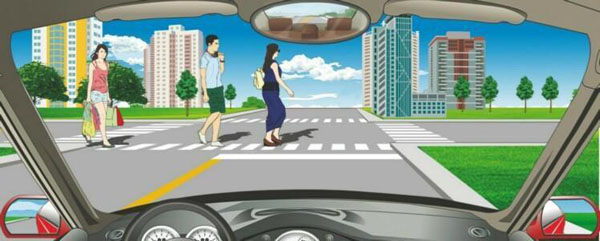
A. Stop and yield to the pedestrians
B. Bypass from the front of the pedestrians
C. Honk to remind the pedestrians
D. Bypass from the rear of the pedestrians
Answer: A
20. The wrong measure to use the brake of a motorcycle is to __________.
A. Simultaneously use the front and back brakes
B. Use the front brake first
C. Use the back brake first
D. Avoid using the front brake too early
Answer: B