

1、What should drivers keep in mind when driving on amountainous road?
A、Keep a safe distance
B、Avoid occupancy of another lane when making a turn
C、Downshift in advance when ascending an abrupt slope
D、Taking full advantage of engine braking when descending a long slope
Answer:ABCD
2、What's the emergency measure to deal with a sudden tire burst on the road?
A、Swiftly braking to slow down
B、Firmly hold the steering wheel and steadily stop the vehicle as early as possible
C、Swiftly turn the steering wheel to adjust the direction
D、Go ahead at a low speed and find a place for tire change
Answer:B
3、When a motor vehicle equipped with ABS makes an emergency brake, the driver can tread the brake pedal heavily.
A、Right
B、Wrong
Answer:A
4、When a vehicle encounters a strong side wind, the driver should firmly hold the steering wheel and press the brake urgently if he feels the vehicle deviates horizontally from the normal direction.
A、Right
B、Wrong
Answer:B
5、It is a bad habit for a driver to put his left arm on the window of the vehicle or hold the gear lever in his right hand for a long time.
A、Right
B、Wrong
Answer:A
6、The sign on the right indicates right-hand turn only.

A、Right
B、Wrong
Answer:A
7、What should the driver do upon finding a burst rear tire?
A、Adjust by swiftly turning the steering wheel
B、Control the direction while reducing speed slowly
C、Swiftly turn the steering wheel to the opposi direction
D、Swiftly take braking measures
Answer:B
8、What should the driver do in this situation?

A、Speed up and overtake from the left side
B、Sound the horn continuously to warn the bicycle
C、Follow the bicycle closely
D、Slow down and yield to the bicycle
Answer:D
9、When driving on this dangerous mountainside road, motor vehicles should drive along the right side of the road.
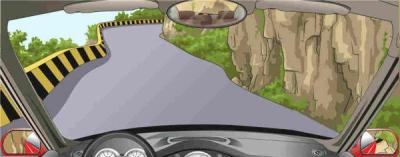
A、Right
B、Wrong
Answer:A
10、If a driver finds there is no vehicle behind, he/she may change lanes without turning on the indicator.
A、Right
B、Wrong
Answer:B
11、Drivers are not allowed to drive on or across these filled-in slanted yellow lines.

A、Right
B、Wrong
Answer:A
12、When approaching another vehicle at night, why should the driver alternate between high-and-low-beam at a distance more than 150 meters?
A、Warn each other before passing
B、Driving habit
C、Easy to observe the situation ahead from either side
D、Courtesy
Answer:C
13、In the condition of low visibility, drivers should turn on the low-beam when setting off

A、Right
B、Wrong
Answer:A
14、The sign on the right warns of a continuous downhill section ahead.
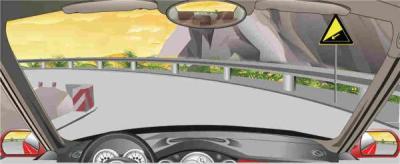
A、Right
B、Wrong
Answer:B
15、When a motor vehicle approaches the exit of a tunnel the driver should firmly hold the steering wheel to prevent any harmful effects of a strong side wind.
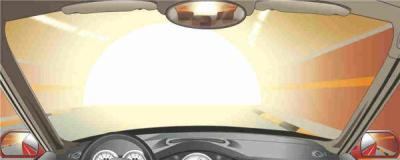
A、Right
B、Wrong
Answer:A
16、When approaching a vehicle on a narrow slope, which one of the following ways is correct?
A、The descending vehicle yields to the ascending
B、The vehicle which is further from the slope crest should yield
C、The ascending vehicle yields to the descending
D、If the descending vehicle has reached the midpoint while the ascending vehicle has not yet set out, the descending vehicle must yield.
Answer:A
17、Under such circumstances, the driver should stop the vehicle and yield to pedestrians.
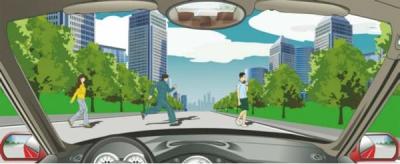
A、Right
B、Wrong
Answer:A
18、Drivers are allowed to cross the broken and solid white line on the road when changing lanes or pulling over.
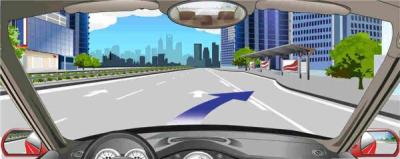
A、Right
B、Wrong
Answer:A
19、The distance-ascertaining section of an expressway is used for the drivers to ascertain the safety distance when the speed is 100 kilometers per hour.
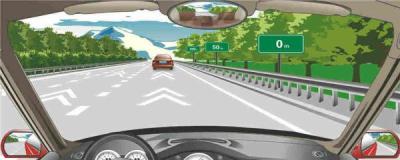
A、Right
B、Wrong
Answer:A
20、When driving on an expressway, which of the following statements is correct?
A、Drives may overtake on either the ramp, the acceleration lane or the deceleration lane
B、Drives are prohibited from reversing, driving in the opposite direction or making a U turn by crossing the central dividing strip
C、Drivers may drive on the emergency lane in a non-emergency case
D、Drives may test a motor vehicle or learn to drive
Answer:B